

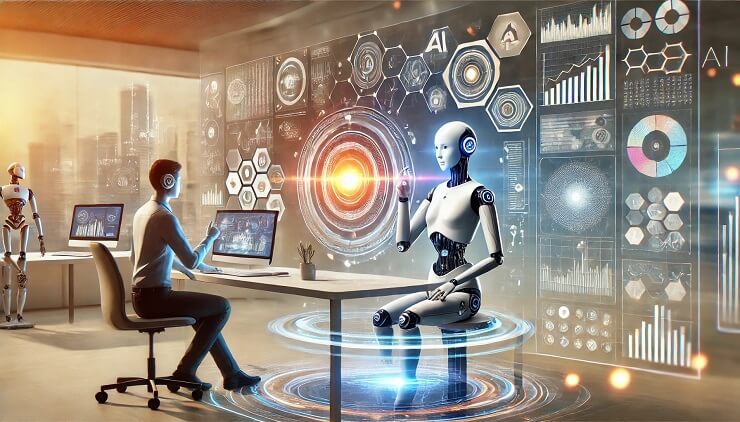
AI vs Human: A Partnership, Not a Competition! How Businesses Are Completing Projects Faster Than Ever.
In today’s business world, speed and efficiency define success. From startups to global enterprises, everyone is searching for ways to get more done without overloading their teams. That’s where Artificial Intelligence (AI) comes in not as a job thief, but as a powerful partner.
Across industries, businesses are now completing 1,000 projects or more in the time it once took to finish 100, thanks to AI-driven collaboration. The secret isn’t replacement, it’s augmentation. AI isn’t removing people from the process; it’s expanding human capacity to think, plan, and create at scale.
Let’s explore how AI and humans are working together to redefine productivity, and why the smartest companies are seeing AI as a collaborative partner, not a competitor.
The Silent Partner Behind the Scenes
AI has quietly become the ultimate team member. It doesn’t clock out, forget tasks, or miss deadlines. Instead, it supports employees by taking over repetitive, time-consuming work, allowing humans to focus on creativity, strategy, and decision-making.
In marketing, tools like ChatGPT, Jasper, and Copy.ai help teams generate high-quality content ideas, captions, and scripts in minutes.
In operations, ClickUp AI and Asana Intelligence automate project timelines, set reminders, and predict potential delays.
In customer support, chatbots like Intercom and Drift resolve 80% of queries instantly—leaving human agents to handle complex cases.
The result? Businesses are completing more projects than ever before—not by hiring more people, but by freeing their existing teams to do their best work.
Humans Still Lead —AI Just Extends the Reach
AI can analyze, automate, and assist but it can’t dream, empathize, or innovate. That’s where humans remain irreplaceable.
In AI-assisted workplaces, people are moving from manual execution to strategic direction.
A designer doesn’t just create graphics they guide AI tools to explore creative possibilities.
A marketer doesn’t just write copy, they use AI to analyze audience trends and optimize campaigns in real time.
A project manager doesn’t just assign tasks, they use AI insights to predict performance and reallocate resources efficiently.
This human-AI synergy has created a new work model: “You do less, but achieve more.” The human provides creativity and context; AI provides speed and precision.
Real Examples: Businesses Scaling 10x with AI Collaboration
Let’s look at real-world scenarios where AI and human collaboration have multiplied project output:
Creative Agencies: Before AI, developing campaign concepts, ad copies, and visuals took days. Now, AI tools generate first drafts in minutes, allowing designers and writers to refine ideas instead of starting from scratch. Impact: Agencies can now handle 10+ client projects simultaneously—without sacrificing creativity.
Software Development Teams: Developers using GitHub Copilot or Tabnine write code 50% faster. These tools predict code snippets, flag bugs, and offer instant fixes. Impact: Teams deliver multiple app updates or features in the time it once took for one major release.
Architecture & Construction: Firms using AI-powered design tools like Autodesk Forma or Midjourney can visualize 3D concepts instantly, cutting planning time from weeks to hours. Impact: Architects can manage dozens of projects at once while ensuring higher accuracy and creativity.
Marketing Departments: AI-powered analytics tools predict customer behavior, segment audiences, and automate campaigns. Impact: Marketing teams are launching 10x more campaigns while personalizing every interaction—something impossible without AI.
These industries aren’t using AI to eliminate roles. They’re using it to eliminate limitations.
Why Businesses That Embrace AI Are Winning
Businesses completing 1,000 projects a year share one thing in common—they’ve built an AI-friendly culture.
Here’s how they do it:
- They integrate AI into daily workflows. Not as a “special tool,” but as a natural extension of their process.
- They train their teams. AI literacy is treated like digital literacy—it’s part of the job.
- They focus on collaboration, not control. Leaders encourage teams to experiment, test, and learn with AI.
- They measure outcomes, not effort. Productivity is tracked through results, not hours worked.
These companies see AI as a force multiplier. Instead of doing more work with the same energy, they’re achieving more impact with the same resources.
From Effort to Efficiency
The traditional model of work relied heavily on human effort. People spent hours on research, documentation, or repetitive admin tasks. AI is flipping that model upside down.
Now, humans focus on ideas, leadership, and innovation, while AI takes care of repetitive execution.
A single marketer can now handle the workload of an entire department using automation and AI analytics.
A single developer can manage multiple projects with real-time coding assistance.
A small business can handle thousands of customers through AI-powered CRM and chatbots.
The shift isn’t about replacing humans; it’s about redefining what humans are capable of achieving.
How to Use AI to Scale Your Own Projects
If you’re ready to increase your team’s capacity, here’s how to get started with AI collaboration:
- Identify Repetitive Tasks: Start by listing the tasks that consume time but add little creative value. Reporting, scheduling, and data entry are great candidates for automation.
- Choose Tools That Fit Your Workflow: Select AI tools that integrate easily with your existing systems. For example:
- Marketing: Jasper, Copy.ai, Writesonic
- Project Management: ClickUp AI, Notion AI, Asana Intelligence
- Operations: Zapier, Airtable Automations, ChatGPT for internal workflows
- Train Your Team, Don’t Replace Them: AI adoption only succeeds when your people understand it. Provide workshops, encourage testing, and celebrate early wins.
- Keep the Human Touch: AI can process data—but only humans can interpret emotion, culture, and creativity. Always keep humans in the loop for final decisions.
- AI vs Human: The Power of Collaboration: The biggest misconception about AI is that it’s here to compete with people. But the reality is completely different.
- AI can analyze patterns, but it can’t understand passion.
- It can generate content, but it can’t tell a story with emotion.
- It can automate workflows, but it can’t replace human connection.
When humans and AI work together, the result is exponential. Businesses become faster, smarter, and more creative—not because AI took over, but because humans finally got the time and tools to think bigger.
That’s why leading companies don’t say “AI vs human.” They say, “AI + human.”
Expanding Human Potential, Not Replacing It
AI isn’t the end of human work; it’s the beginning of a smarter one. Businesses that once struggled with deadlines and capacity are now delivering thousands of projects smoothly because they learned one powerful truth:
AI doesn’t replace people. It replaces limitations
The future belongs to teams who see AI as a collaborator a digital teammate that helps humans focus on what truly matters: ideas, innovation, and impact.
When AI handles the heavy lifting, humans can lead with creativity. And together, they can achieve what neither could do alone.
So yes, the next 1,000 projects your business completes won’t be AI’s victory or yours—it’ll be proof of partnership.
